1. Color sorting: a key battle in the gemstone industry
In the value assessment system of gemstones, color occupies a decisive position. The price difference of a diamond can be dozens of times, probably simply because the color grade jumps from D to E. Traditional sorting relies on the naked eye observation of appraisers, not only to remember hundreds of standard color charts, but also to combat errors caused by visual fatigue. In the Myanmar jade market, experienced masters process up to 200 rough stones per day, and the emergence of AI systems has increased this number by 200 times.
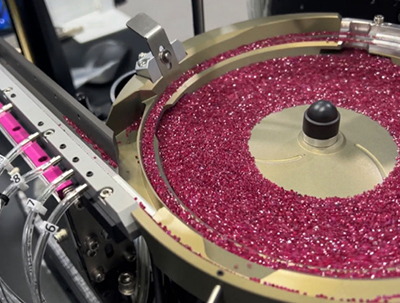
The difficulty of color sorting lies in its complexity: the "cornflower blue" of sapphire needs to meet the delicate balance of hue, saturation and brightness at the same time; The "Wharton Green" of emerald presents different shades under different lights; The yellow grading of diamonds requires identifying subtle differences that are difficult to detect with the naked eye. These "intuitive judgments" that humans need to practice for decades are what deep learning is best at.
2. The "three axes" of AI deep learning
1. Convolutional Neural Networks: Establishing a "Digital Fingerprint" of the Gemstone When
a hyperspectral camera performs a 360-degree scan of the gemstone, the AI system is building a digital model with millions of data points. Convolutional neural networks (CNNs) are like sophisticated filters, analyzing color features layer by layer - layer by layer identifying basic color blocks, the second layer analyzes color transitions, and the deep network finally forms an understanding of professional color gamuts such as "pigeon blood red" and "royal blue". According to data from a laboratory, the color recognition accuracy of the model trained on 500,000 ruby images can reach 99.7%, far exceeding the 92% of human experts.
2. Counter Generative Networks: Cracking the "face-changing" feature of the Light Magic
Gem once left machines helpless. Innovative applications of generative adversarial networks (GANs) solve this problem: one network is responsible for simulating different lighting environments, and the other is learning to remove light interference to extract essential color features. Just like accurately identifying the true color of an object under the changing neon light, this technology has improved the outdoor sorting accuracy of a jewelry testing center in Shenzhen by 38%.
3. Transfer Learning: Small samples of big intelligence
In the face of data scarcity for rare gemstones, transfer learning shows amazing potential. The researchers "grafted" the visual understanding ability obtained from ImageNet's tens of millions of images training into the colored diamond recognition task. This method allows the AI to master the 9-level color classification of pink diamonds with only 300 samples, increasing the training efficiency by 40 times. The case of the New York laboratory proves that this ability to "draw inferences from one case to another" is particularly suitable for dealing with rare varieties such as Paraiba tourmaline.
3. Practical map of intelligent sorting system
Diamond Color Revolution
De Beers Group's "Diamond Passport" system constructs the "color DNA" of diamonds through spectral imaging from 7 different angles. Traditionally, GIA grading required three experts to judge back-to-back, but now the AI system can complete 93 grades from D to Z in 0.8 seconds, and the grading consistency has increased from 85% to 99.5% of manual classification.
The Awakening
of Colored Gemstones At Sri Lanka's Sapphire Mine, mobile sorting trucks are rewriting the game. The equipment equipped with a depth camera completes the initial screening directly on site, and the raw materials are divided into 20 grades according to the color system. Raw material grading, which used to require 3 weeks of turnover, can now enter the cutting process in 8 hours, and the raw material utilization rate has increased by 27%.
The jade industry is broken
to the cruel reality that the jade color is "ten times worse", and the jade sorter developed by an enterprise in Yunnan adopts multispectral fusion technology. It can not only distinguish 32 green subcategories such as yang green and apple green, but also identify the dyeing characteristics of B+C goods. Last year, on the Pingzhou public market, this system successfully warned of the dyed jadeite rough with a price of 30 million yuan.
4. The triple challenge of technological evolution
The dilemma
of data desert The annual production of pigeon blood rubies is less than 100, and the establishment of a reliable database requires global laboratory collaboration. An international jewelry association is pushing for an open-source color database, but data sharing involving trade secrets remains a challenge.
Limitations of Optical Systems
Existing equipment still struggles to fully simulate natural light changes when identifying alexandrite discoloration effects. The newly developed omnidirectional lighting cabin by the Chinese Academy of Sciences team is breaking through this bottleneck by combining 2,000 lighting conditions through 128 sets of LEDs.
The new paradigm of human-machine collaboration is not suitable for machine replacement in all scenarios.
At Sotheby's, the AI system is responsible for the initial screening, and the experts focus on handling 1% of disputed cases. This model of "AI sand screening, experts panning for gold" has increased the efficiency of colored diamond identification by 6 times.
5. The future is here: redefining gemstone value
In the gemstone market in Chanthaburi, Thailand, handheld sorters are changing the way transactions have been conducted for centuries. Miners scan rough with a mobile-sized device to get a color rating reference in real time. The access of blockchain technology allows the color data of each gemstone to be traced from the mine to the counter.
A more far-reaching impact is emerging: intelligent color sorting lowers the industry threshold, allowing more small and medium-sized merchants to obtain professional-level appraisal capabilities; the AR try-on system on the consumer side matches clothing according to color data; Even the insurance industry has begun to use AI color ratings as a pricing basis. Ten years after Alpha Dog defeated Go, AI proved in the gemstone field that better landing scenarios of artificial intelligence are often hidden in the most traditional industries.
This color revolution is far from over. With the breakthrough of quantum dot spectroscopy technology, we may see AI identify color dimensions that are invisible to the human eye in the future. At that point, the color grading of gemstones will no longer be a simple description of natural creations, but will open up a whole new dimension of visual cognition. Just as the invention of the microscope has changed the understanding of gemstone inclusions, AI deep learning is redefining the quantitative understanding of beauty.