In glass disk inspection equipment, different LED light sources highlight defect characteristics through specific optical characteristics, the following is a detailed explanation of the role and usage of ring, bar, backlight, coaxial light source and spherical integral light source:
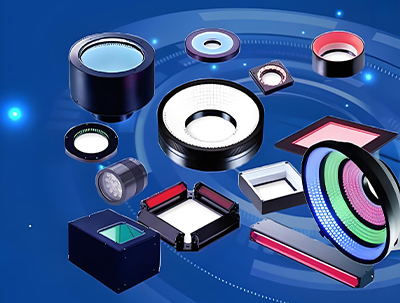
1. Ring light source
Function:
Provides uniform 360° frontal illumination for surface scratches, edge defects, foreign objects, or translucent defect detection.
Usage in glass plate inspection:
Installation method: Arranged around the industrial camera lens in a ring, the light source is 15°~45° inclined to the surface of the glass disk.
Applicable scenarios:
Detect minor scratches on the glass surface (oblique lighting creates chiaroscuro).
Identify uneven coatings or stains (by diffuse reflection differences).
Combined with polarizers, mirror reflections can be suppressed and image quality improved.
Parameter optimization: High-density LEDs (such as SMD patch) are used to improve uniformity, and RGB multi-color light sources are available to enhance the contrast of specific defects.
2. Bar light source
Function:
Provides directional linear illumination to highlight edges, contours, or specific angle imperfections.
Usage in glass plate inspection:
Installation method: multiple groups of strip light sources are symmetrically distributed on both sides of the detection area, and the angle is adjustable (such as 30°~60° side light).
Applicable scenarios:
Detect chipping or cracks in the edges of the glass (shadows formed by side light projection).
Identify surface foreign objects (highlighting height differences by oblique light).
The multi-axis combination enables darkfield illumination to capture tiny scratches.
Extended application: Dynamic scanning detection with motion platform is suitable for large-area glass discs.
3. Backlight (backlight)
Function:
Uses transmitted light to highlight contours, internal structures, or transparent material defects.
Usage in glass plate inspection:
Installation method: Placed under the glass disk, the light source and the camera are separated on both sides of the object to be measured.
Applicable scenarios:
Detects bubbles, impurities, or internal cracks (transmitted light is scattered by defects to form dark spots).
Measure geometric dimensions (e.g., hole size, roundness) or thickness uniformity.
Use high-brightness LEDs (such as blue bands) to enhance the contrast of imperfections inside the glass.
Technical points: High uniformity diffusion plate is required to avoid spot interference; High requirements for light transmittance consistency.
4. Coaxial light source
Function:
Illumination parallel to the camera's optical axis is achieved through a beamsplitter, suppressing reflections and highlighting plane defects.
Usage in glass plate inspection:
Installation method: The light source is projected vertically onto the glass surface through the beamsplitter, and the reflected light enters the camera.
Applicable scenarios:
Detects micron-scale scratches or foreign objects on smooth surfaces (with significant differences in parallel light reflection).
Identify peeling coatings or oxidation spots (avoid ambient light interference).
Suitable for defect detection of highly reflective glass, such as mobile phone cover glass.
Optimization strategy: Eliminate stray light with polarizing filter and improve signal-to-noise ratio.
5. Spherical Integral Light Source (Dome Light)
Function:
Uniformly diffused light is formed through multiple reflections of the hemispherical inner wall, eliminating directional reflection.
Usage in glass plate inspection:
Installation method: Place the glass disk at the opening of the integrating sphere, and the light source shines evenly from the ball wall.
Applicable scenarios:
Detects complex surface defects in curved glass (e.g., 3D curved covers).
Eliminate specular reflection interference and are suitable for multi-angle reflection detection scenarios.
Detect the uniformity of matte surfaces or frosted glass.
Limitations: The size of the integrating sphere needs to be customized according to the detection area.
Comprehensive application recommendations
Multi-light combination solution:
Surface + internal defects: coaxial light source (surface scratches) + backlight source (internal bubbles).
Complex defect detection: ring light source (global illumination) + bar light source (edge enhancement).
Wavelength selection:
Dynamic Detection:
Optical Accessories:
Typical defect detection comparison table
Defect type
Recommended light source
Detection principle
|
|
|
Surface scratches | Ring light source (low angle) | Oblique light creates a chiaroscuro contrast |
Internal bubbles/impurities | Backlight (Blue LED) | Transmitted light scattering differences |
The edges are broken | Bar Light Source (Lateral Darkfield) | Shadow casting highlights outline anomalies |
Specular interference | Coaxial light source + polarizer | Eliminates stray reflected light |
Uneven surfaces | Spherical integral light source | Multi-angle diffused illumination |
By properly configuring the light source type, angle, wavelength, and optical accessories, the accuracy and efficiency of glass disc defect detection can be significantly improved. In practical applications, it is recommended to determine the optimal lighting scheme through experiments, and consider the real-time requirements of online detection.