1. Why is traditional testing inadequate?
In the production hall of an electronics factory, quality inspectors need to inspect thousands of glass plates with a microscope every day. Staring at the glass surface under strong light for a long time will cause visual fatigue to the human eye, resulting in a missed detection rate of up to 15%-20%. Although traditional machine vision systems are faster, they often have "misjudgments" when facing complex scenarios such as glass reflection and curved edge detection.
A quality inspection supervisor once compared it to this: "Just like asking a newly graduated student to be able to see 1/10 of the thickness of a hair, but also to be able to instantly distinguish 30 different types of defects, which is simply difficult for a strong person." "
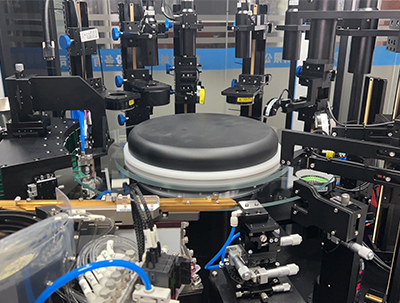
2. The three stunts of AI visual inspection
Super feature recognition AI
can accurately identify microscopic scratches of 0.01mm through deep learning of millions of defect images. Just like a well-trained treasure appraiser, he can not only find defects, but also determine the type of defect: is it a raw material bubble? Or is it a chipping edge during processing?
Experts in dealing with complex scenes
For glass reflection problems, the AI system will intelligently analyze the lighting images from different angles. Just like a photographer uses multiple lights to eliminate shadows, the system thoroughly "sees" through the glass surface by fusing data from multiple light sources.
The smarter the quality inspector
when a new defect is found, the engineer only needs to mark a small number of samples, and the system can update the inspection model autonomously. Application data from a smart watch manufacturer shows that half a year after the system was launched, the false positive rate dropped from the initial 2.3% to 0.5%.
3. The whole process of AI detection on the production line
360-degree scanning
of 12 sets of 50 million pixel industrial cameras without dead ends to form a detection matrix, completing all-round shooting of the front and back and surrounding frames within 0.8 seconds, which is equivalent to taking pictures of the glass disk with 1,200 mobile phones at the same time.
The intelligent algorithm triple filter
layer neural network quickly screens obvious defects. the second level of professional model analysis complex defects; Finally, the 3D point cloud reconstruction technology is used to detect the arc accuracy of curved glass.
Real-time quality big data
inspection results generate visual reports in real time, and production supervisors can view the defect distribution heat map at any time. A tablet manufacturer used this data to reduce the defect rate of the coating process by 37%.
4. Practical cases of changing the industry
After an international mobile phone brand introduced an AI testing system, the number of quality inspectors in a single production line was reduced from 15 to 3, and the testing speed increased to 45 pieces per minute. More importantly, it has achieved "zero customer complaints" - the problem of batch returns caused by minor scratches in the past has completely disappeared.
In curved screen inspection, the AI system has shown amazing ability: it can accurately identify microcracks as small as 0.1mm at the edge, which would be misjudged as normal reflection in traditional optical inspection. Test data from automotive central control screen manufacturers shows that AI has improved the detection accuracy of curved areas from 78% to 99.6%.
5. The future picture of intelligent manufacturing
With the popularization of 5G+ edge computing technology, future AI testing equipment will become more "lightweight". The testing module, which is only the size of a lunch box, can be directly embedded in the real-time quality inspection of production equipment. What is more worth looking forward to is the application of "meta-learning" technology, and the training time of the detection model of the new product is expected to be shortened from two weeks to two days.
Industry experts predict that by 2026, more than 90% of 3C electronics manufacturers will adopt AI visual inspection. This quiet quality revolution is reshaping the quality standard of "Made in China" - so that every glass cover can stand the test of the microscope and every electronic product has a flawless "face".
From manual visual inspection to AI intelligent inspection, it is not only an upgrade of technology, but also an innovation of manufacturing concepts. When the "quality inspector" on the production line becomes a tireless AI system, we get not only an improvement in efficiency, but also an unremitting pursuit of "zero-defect" manufacturing. This may be a better gift to the manufacturing industry in the intelligent era: use the eyes of science and technology to protect perfect quality.